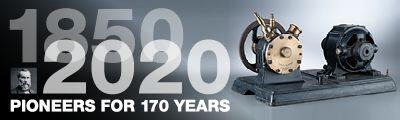
Cologne, April 2020 – Traditionally, companies can only be sustainable if they are
innovative. The vacuum specialist Leybold succeeded with its combination of
tradition and innovation over the course of its history. With this in mind, Leybold
is proud to honor this important milestone by celebrating its 170th birthday in
2020.
https://www.photos-videos.leybold.com/history
The foundation of success
Without the tireless work and commitment of several generations of dedicated employees, this
anniversary would not have been possible. The businessman Ernst Leybold laid the foundation
in 1850, when he moved from Rotenburg ob der Tauber to Cologne founding his first company.
Initially as a commission and forwarding agency for medical glassware, ointment pots,
thermometer and scales; he expanded his range of products in 1854 to include physical,
pharmaceutical and chemical apparatus. Leybold finally sold his business in 1870, though it
continued to operate under the name of E. Leybold’s Nachfolger.
Beneficial cooperation
The triumphant procession of vacuum technology began in 1906 through collaboration with Dr.
Wolfgang Gaede, professor of physics in Karlsruhe. Gaede’s work ethic was characterized by
efficiency: “If I pursue an idea out of scientific interest, I always come up with an invention.” The
cooperation between Leybold and Gaede was accordingly beneficial, among other things it
produced innovations which are still very important today, such as the invention of the molecular
air pump, the basic principle of the turbomolecular pump (1911), and the use of the diffusion
pump (1913). Diffusion pumps have no moving parts – their operating principle is based on
vaporous propellants and enables reliable, low-maintenance operation. These robust
“workhorses” are still used in applications today. Gaede’s gas ballast device for efficient
pumping of vapors – patented in 1935 – is still used in many applications today.
Milestone in vacuum coating technology
The year 1913 marks the beginning of vacuum metallurgy. At that time, Dr. Wilhelm Rohn, head
of the physical test laboratory at W.C. Heraeus GmbH in Hanau, developed a process for
melting high-purity metals under vacuum. Interrupted by WWI the “process for vacuum melting
and tempering of metals and alloys” could only be patented after the war in 1918. In 1931
Wilhelm Carl Heraeus succeeded in vaporizing metals onto glass – another milestone in
vacuum coating technology.
Industrial use of the vacuum
Dr. Manfred Dunkel took over as managing director at E. Leybold’s Nachfolger in the same year
(1931) and led the company successfully until 1967. This period was defining, as vacuum
technology was increasingly used in the florishing industry during this time. Therefore, technical
and scientific knowledge as well as management skills were required, in order to transfer the
findings into process engineering applications.
Vacuum and process engineering in the portfolio
The Metallgesellschaft AG and the Degussa AG secured participations in E. Leybold’s
Nachfolger in 1948 and 1955. This generated synergies, ensured success on the world markets
and led to a merger of E. Leybold’s Nachfolger and Heraeus Hochvakuum GmbH in 1967. The
result was a well-mixed portfolio of vacuum technology and vacuum process engineering.
Further growth resulted from product developments such as cryogenic pumps with liquid helium
(1962), and helium leak detectors. In 1963, Ion atomizer pumps were presented for the first
time.
Strong growth, economic turbulence
The 1980s were shaped by strong growth. By 1987, Leybold had expanded to about 5600
employees and achieved a turnover of more than one billion D-Mark. Fundamental changes in
the ownership structure took place within the same year; The Metallgesellschaft AG withdrew as
a shareholder and W.C. Heraeus also disposed of its shares. This resulted in the Degussa AG
now being the sole shareholder. The headquarters of the ‚Leybold AG’ and the sector of
vacuum process technology moved to the Hanau location. Vacuum Technology was located in
Cologne and scientific and technical teaching materials were in Hürth. With the opening of the
Iron Curtain in 1989, and the economic downturn of the western industrialized countries, the
new Leybold AG experienced great economic turbulence. This resulted in the Degussa AG
selling its shares to the Oerlikon-Bührle Group (Switzerland) in 1994. 1995, the Leybold AG and
the Balzers AG were merged into the Balzers and Leybold Group.
Focus on semiconductor technologies
In 1997, Leybold GmbH founded a wholly owned subsidiary in China in order to profit from the
high potential of the emerging economic region and customer proximity. In 2000, the Oerlikon-
Bührle Group was renamed UNAXIS, accompanied by extensive restructuring by focusing on
semiconductor related technologies. This required innovations in the manufacturing technology
which Leybold met by opening the new production building for high vacuum technology in
Cologne in 2004. Supported by economic growth, the UNAXIS Group was renamed to
“Oerlikon” in 2006. Leybold operated under the name Oerlikon Leybold Vacuum until its sale to
Atlas Copco.
Acquisition by Atlas Copco
In 2016, the Swedish Atlas Copco AB acquired Leybold. Atlas Copco is a multi-brand group with
customers in over 180 countries and about 37000 employees. Today, Leybold is part of Atlas
Copco’s Vacuum Technique business area. Atlas Copco is relying on Leybold’s traditional brand
strength and on complementing the innovative technological know-how.
Synergy between Atlas Copco and Leybold
For 170 years, Leybold - with headquarters in Cologne, Germany - has been developing and
supplying vacuum pumps, systems, standardized and customized vacuum solutions and
services for many different industries. Today, Leybold is leading as a supplier of vacuum
technology in many industrial applications; such as metallurgy and industrial coating technology.
The synergetic performance of Atlas Copco and Leybold in the fields of industrial dry vacuum
pumps and high vacuum pumps for science and research has created a technological platform
for the development of sustainable high-performance products for future generations.