
Six weeks after Artemis II’s crewed lunar flyby, the engineering gap blocking a Moon landing goes to the test floor
Fifty college teams open three days of autonomous robot trials at Florida’s Kennedy Space Center on Tuesday, testing what may be the single most stubborn engineering problem on the path to a sustained human presence on the Moon: how to move sharp, glass-like lunar soil reliably enough to build infrastructure. The 2026 Lunabotics Challenge runs May 19–21 at the Astronauts Memorial Foundation’s Center for Space Education, and every robot on that floor is an experiment in whether the problem has gotten any closer to solved.
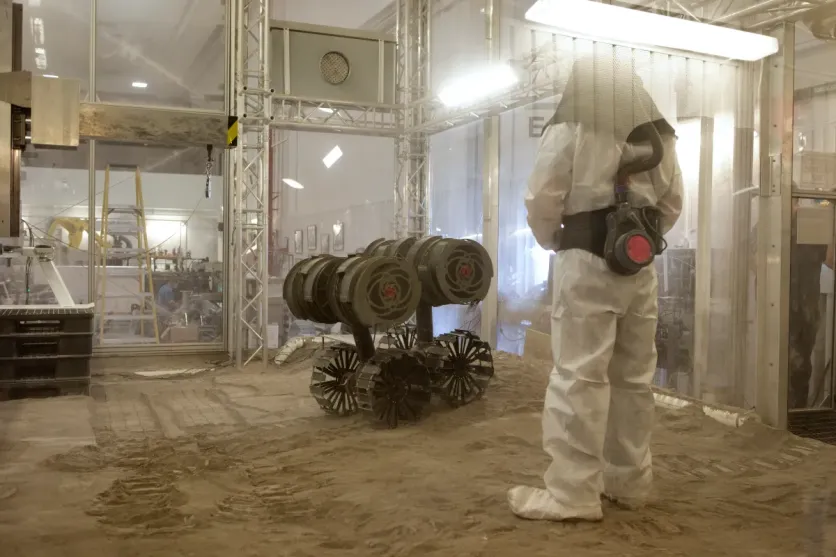 (Each robot competing this week must navigate a lunar regolith simulant — engineered lunar-analog soil produced at the University of Central Florida’s Florida Space Institute Exolith Lab, which specializes in high-fidelity planetary soil analogs. Credit: NASA)
The timing is not incidental. On April 10, six weeks ago, NASA astronauts Reid Wiseman, Victor Glover, and Christina Koch, along with Canadian Space Agency astronaut Jeremy Hansen, splashed down in the Pacific after completing the first crewed lunar flyby in 54 years. Artemis II validated the Orion spacecraft and Space Launch System for crewed deep-space operations. Artemis IV, targeted for a South Pole landing in 2028, is meant to put people on the surface. What happens on the Kennedy competition floor this week is part of the engineering foundation that separates those two milestones.
Regolith Excavation Blocks Every Other Goal on the Moon
Lunar regolith is not a material that yields to conventional machinery. Billions of years of micrometeorite bombardment, with no wind or water to round the particles, has left the Moon’s surface covered in angular shards that behave more like powdered glass than sand. Under vacuum conditions, the particles carry electrostatic charges that cause them to cling to any surface they contact. They work into mechanical joints, grind down seals, and destroy bearings within hours of operation.
The engineering literature is unambiguous on the point: no excavation design yet developed is a fully optimized solution to the geotechnical conditions of the lunar surface. Abrupt increases in soil resistance with depth, traction losses on loose regolith, and mechanical failure from abrasive dust are documented failure modes across every prototype class studied — auger systems, bucket ladders, pneumatic excavators, and wheeled haulers alike.
The stakes of getting it right extend well past moving dirt. NASA’s in-situ resource utilization program — its framework for extracting oxygen, water ice, and eventually rocket propellant directly from lunar material rather than hauling it from Earth — requires reliable, high-volume regolith excavation at its foundation. Water ice in permanently shadowed polar craters must be excavated before it can be processed. Oxygen must be extracted from regolith oxides. Without a machine that can dig and move lunar soil reliably, none of the downstream chemistry is reachable.
“Excavating and moving regolith is a fundamental need to build infrastructure on the Moon and Mars,” said Robert Mueller, NASA senior technologist at Kennedy’s Exploration Research and Technology Programs Directorate and co-founder and chief judge of the Lunabotics competition. “This competition creates 21st-century skills in the future workforce.”
What the 50 Teams Are Actually Building
Each robot competing this week must navigate a lunar regolith simulant — engineered lunar-analog soil produced at the University of Central Florida’s Florida Space Institute Exolith Lab, which specializes in high-fidelity planetary soil analogs — and construct a berm around simulated Artemis infrastructure. Berms are not an incidental engineering exercise. On the actual lunar surface, they would serve four distinct functions: shielding sensitive equipment from the debris kicked up by rocket landings and launches; shading cryogenic propellant storage tanks against the Moon’s extreme thermal cycling; providing radiation shielding around nuclear power systems; and serving as blast barriers for crewed facilities.
“The task of robotically building berm structures will be important for preparation and support of crewed lunar missions,” said Kurt Leucht, NASA software developer, in-situ resource utilization researcher at Kennedy, and Lunabotics commentator. “These competing teams are not only building critical engineering skills that will assist their future careers, but they are literally helping NASA prepare for our future Artemis missions to the Moon.”
The competition follows a two-stage format. An in-person qualifying round ran the week of May 14 at the UCF Exolith Lab in Orlando, from which the top 10 teams advanced to this week’s Kennedy finals in the Artemis Arena. The team that accumulates the most points over all three competition days wins the Lunabotics Grand Prize and an invitation to an exhibition event at NASA Kennedy. Caterpillar, the primary private-sector sponsor of the competition, funds a separate Autonomy Award — with first place carrying $2,000 — for the team that demonstrates the strongest autonomous robot operation.
To read the rest of this article visit www.cold-facts.org or click here